(Wingham, North Huron) North Huron council is now holding meetings in person as required by law. To date, no lawful justification or authority has been cited for the suspension of Democracy since February 19th by current CAO Nelson Santos. During this time, North Huron decided to sell off the museum building without any public consultation, and forcing new garbage fees and collection upon us. Don’t worry, if you don’t like your upcoming skyrocketing taxes as a result of this abuse of power, don’t pay your taxes in protest, and they sell you your home in 2 years. You have no say, no voice, no power. If you doubt that, read the next paragraph or watch the meeting.
Despite CAO Nelson Santos’ checkpoints and attempt to block the Free Press from the building, an Editor walked in without ID, wearing a “Press” hat, and was able to record the checkpoint and meeting without any scrutiny at all. No metal detectors, no pat downs, no knife or weapons check, no ID. Now you might be disappointed that your taxes are going up to cover this “security upgrade” that a toddler could defeat, and you would be justified. Just like dangling keys to distract a baby, two “decoys/stunt doubles” were deployed earlier. Once the inept security believed they neutralized the alleged “threat” they stood down for the evening, and anyone could walk in without scrutiny, even if they “hatted up”.
At last night’s council meeting, https://www.youtube.com/watch?v=2oMl7v2bxEs a Wingham Ward councillor complained that he has no idea what is going on at council or in town. He said he finds his information out from the public, or social media posts, and says he can’t answer questions because he has no idea what is going on. If you needed absolute proof that our democracy has failed, this is it. When questions were removed from council meetings, democracy died. No questions means no discussion, no debate, no new issues brought to light, no accountability, no clarification, no freedom of the press, no freedom of expression.
FACTS: A councillor has come forward and openly declared our Democracy Is Broken. Another councillor believes Canada’s Supreme law is wrong, and that Freedom of the Press and expression is a “dangerous thing”. Those that believe that, do not conform to Canadian Ideals or Law, and should not be considered “Canadian”. We stand on Guard for Thee. Thee is Canadian Democracy and our Ideals of Democracy, something over 2.3 million Canadians have fought for, and 118,000+ have died for. This is why it is our DUTY to respect the Fallen at the Wingham Cenotaphy by maintaining it, and not dumping snow on its sidewalks. 01Dec2025 a volunteer that shoveled the Cenotaph sidewalks and steps asked council to stop blowing snow on the sidewalks he freshly shoveled, by simply diverting the snowchute on the trackless, a fraction of a second of effort to show respect. They flatly refused to stop showing that disrespect, and things have continued to escalate.
(Wingham, North Huron) After months of controversy, public debate, virtual meetings, and growing frustration from residents, North Huron Council is scheduled to return to an in-person council meeting on June 1st. Many citizens are calling it one of the most important municipal meetings in recent memory.
Attendance is expected to be exceptionally high as residents from across North Huron prepare to exercise one of the most fundamental rights in a democratic society: showing up, asking questions, and holding elected officials accountable.
CAO Neslon Santos and Council are expected to setup several “Show me your papers” checkpoints to ensure only those that fully comply will be allowed democracy.
For many, this meeting represents far more than routine municipal business. It is an opportunity to participate directly in local democracy and seek answers on issues that have dominated community conversations for months.
Residents have indicated they intend to ask questions regarding the Museum “sale”, proposed changes to garbage and recycling collection, security spending, council transparency, and the municipality’s proposed communications policies.
Others are seeking clarification regarding decisions that resulted in council meetings becoming virtual, as well as the legal authority relied upon for various administrative actions taken during that period.
Questions surrounding governance, transparency, public participation, and municipal accountability are expected to dominate discussions both inside and outside council chambers.
The cornerstone of local democracy is not social media. It is not rumours. It is not anonymous comments online.
It is citizens walking through the doors of Town Hall and speaking directly to the people they elected and the officials they pay to administer public services.
Many residents believe this meeting could shape the tone of municipal government for years to come.
“If you’ve ever complained about council, this is your chance,” said one resident. “Don’t complain from your couch. Show up.”
The renewed public interest has created a sense of anticipation rarely seen in local politics. Some residents are already referring to the event as the “Wingham Stampede” as word spreads across the community.
Whether citizens support council, oppose council, or simply want information, many agree on one thing: participation matters.
Democracy only works when people show up.
The June 1st meeting offers every resident an opportunity to witness local government firsthand, ask questions, hear answers, and decide for themselves what kind of community they want North Huron to be.
History is usually written by the people who show up.
(Wingham, North Huron) Parents across the region are demanding that the Avon Maitland District School Board finally abandon outdated “zero tolerance” thinking that many say punishes victims while bullies continue unchecked.
Numerous parents have come forward alleging that students at F.E. Madill Secondary School and other area schools are punished when they finally defend themselves after months or years of bullying and harassment.
Critics say teachers and administrators too often ignore ongoing abuse until the victim finally snaps or fights back — then suddenly discipline is enforced.
Ontario officially moved away from “zero tolerance” discipline in 2008, replacing it with “progressive discipline,” which requires schools to consider context, prior bullying, power imbalance, self-defence, disability, and student safety before punishing students.
But many parents say schools still operate under the old:
“Both kids fought, so both kids are guilty.”
mindset.
Community frustration has now reached the grandfather stage — and according to multiple local families, area grandpas are giving blunt advice to their granddaughters:
“If some boy keeps putting his hands on you, kick him in the nuts and end it immediately.”
Many laughed when hearing the advice — but behind the humour is serious anger and fear from families who believe schools are failing to protect vulnerable students before situations escalate.
Parents say children are being taught to:
stay quiet,
tolerate abuse,
avoid defending themselves,
and “suffer in silence” until the school finally notices.
Buck & Jo’s announced it will offer free ice cream to students suspended or punished after defending themselves from bullies, saying the gesture is meant to support students who feel abandoned by the system.
“Kids should not be conditioned to become silent victims,” one parent said. “Schools are supposed to stop bullying before a child reaches the breaking point.”
Residents are now calling on AMDSB to:
intervene earlier,
enforce anti-bullying rules consistently,
protect vulnerable students,
and stop treating victims and aggressors as morally equivalent once a victim finally reacts.
Parents say the message to students should not be:
“Take the abuse quietly.”
They say the message should be:
“Report bullying early, stand up for yourself safely, protect others when you can, and never accept being treated as less than human.”
(Wingham, North Huron) Public outrage continues after the Ontario Provincial Police confirmed no charges are currently being laid in the horrific incident involving a student severely burned at F.E. Madill Secondary School.
Community members are asking how an investigation can be considered complete while the victim reportedly remains unable to fully speak for himself.
Critics argue that even if no criminal act directly caused the fire itself, years of alleged bullying, humiliation, coercion, harassment, and social isolation may still carry legal consequences.
Across Canada and the United States, courts have increasingly recognized that relentless bullying is not merely “drama” or “kids being kids.” In many cases, it has crossed into:
criminal harassment,
uttering threats,
extortion,
counselling self-harm,
negligence,
and civil liability.
One of Canada’s most famous precedents is the Suicide of Dawn-Marie Wesley, where teen bullies were criminally convicted after years of threats and harassment preceded a young girl’s suicide.
The deaths of Amanda Todd and Rehtaeh Parsons also changed Canadian law and public understanding of psychological abuse.
In the United States, the Suicide of Phoebe Prince led to criminal charges and sweeping anti-bullying reforms after sustained harassment at school.
Legal experts increasingly warn that bullying can create foreseeable harm, especially when:
the abuse is prolonged,
adults allegedly fail to intervene,
warning signs are ignored,
or vulnerable youth are isolated and targeted.
Parents and students in Wingham say the deeper issue is that nothing substantial appears to have changed.
“The conditions still exist,” said one concerned parent. “That should terrify everyone.”
Students continue to describe a culture where bullying is normalized, ignored, minimized, or treated as entertainment until tragedy strikes.
Advocates are now calling for:
independent review,
stronger anti-bullying enforcement,
counselling supports,
anonymous reporting systems,
and a student-led movement encouraging youth to stand beside victims instead of remaining silent bystanders.
Because many believe the real question is no longer simply:
“Who lit the fire?”
But also:
“What culture allowed a child to reach that point?”
(Wingham, North Huron) Democracy in Canada does not belong to a CAO. It does not belong to a clerk, a police officer, or a politician. Council chambers are supposed to be a sacred democratic space where the public can observe, question, criticize, and hold elected officials accountable. That right does not disappear because a municipal employee becomes uncomfortable with scrutiny, cameras, or tough questions.
Yet in North Huron, residents say that is exactly what happened.
For months, controversy has surrounded the actions of North Huron CAO Nelson Santos after he issued trespass notices and effectively banned members of the public and press from council chambers. Critics argue Santos never had the legal authority to do so in the first place, and that the entire situation represents one of the most dangerous examples of administrative overreach seen in recent local politics.
At the heart of the issue is a simple legal question:
Who actually has authority over council chambers during a council meeting?
CAO Authority Abuse BUSTED!
Under Ontario’s Trespass to Property Act, trespass notices can only be issued by an “occupier” of the premises or someone authorized by the occupier. During council meetings, the occupier is arguably council itself — not an unelected employee acting alone. In practical terms, that means authority would need to be explicitly delegated by council through a bylaw, resolution, or formal motion.
Critics say North Huron cannot demonstrate that such authority was ever granted to Santos.
If that authority does not exist in writing, then Santos was acting merely as an employee — not as the lawful occupier of council chambers. Employees do not get to suspend democracy because they dislike criticism.
Residents point out that council meetings are not private corporate boardrooms. They are public governmental proceedings funded by taxpayers. The public gallery exists specifically so citizens and press can observe their government in action. Arbitrary exclusion from that space raises serious constitutional concerns involving freedom of expression, freedom of the press, open government principles, and democratic participation.
Even more alarming to many residents is the precedent being set.
If a CAO can unilaterally decide who is allowed into council chambers, then democracy itself becomes conditional upon the approval of one bureaucrat. Today it may be a citizen journalist. Tomorrow it could be a political opponent, an activist, or anyone asking uncomfortable questions.
That is precisely why power is supposed to remain with elected council as a collective body — not concentrated in one unelected administrator.
The controversy escalated after repeated disputes over filming, questioning councillors before meetings, and public criticism of council operations. Residents and independent media argue they were targeted not for disruption, but for exercising democratic oversight through cameras and public questioning.
Questions before council meetings were once common practice in North Huron. Critics say those traditions disappeared only after public scrutiny intensified.
The situation reached a boiling point during multiple council meetings in late 2025 and early 2026, including incidents involving police intervention, removals from the public gallery, demands for identification, and arrests connected to filming and attendance at meetings.
On Dec. 15, 2025, OPP Public Liaison Team officers attended a council meeting after concerns were reportedly raised by township officials about public scrutiny and recording.
On Jan. 12, 2026, members of the public and press were removed from council chambers before the official meeting even began.
On Feb. 2, 2026, further arrests occurred involving passive recording inside council chambers.
By March 2026, council meetings moved virtual, effectively eliminating in-person public interaction altogether.
Critics argue the move to virtual meetings was less about safety and more about controlling scrutiny, cameras, and accountability.
Throughout the controversy, residents repeatedly challenged Santos and council to produce documentation proving the CAO possessed delegated authority to issue trespass notices under the law. According to critics, no such authority has ever been publicly demonstrated.
That absence matters enormously.
In law, authority cannot simply be assumed because someone has a title. Government officials must be able to point to the exact source of their power. If they cannot, their actions may be unlawful, unenforceable, and potentially unconstitutional.
Critics further argue that even if authority had existed, banning individuals from council meetings would still require justification grounded in actual disruption or safety concerns — not mere discomfort over criticism, cameras, or questions.
Asking questions before a meeting is not violence. Filming public officials is not violence. Criticizing politicians is not violence.
In a free society, scrutiny is not harassment.
Courts across Canada have repeatedly emphasized that open government and public accountability are foundational democratic principles. Council chambers are not supposed to operate like gated private clubs where officials decide which citizens are worthy of participation.
Many residents now believe the core issue extends far beyond one municipality.
They warn that if unelected municipal staff can issue arbitrary bans without clear delegated authority, then any municipality in Ontario could weaponize trespass laws against critics, journalists, whistleblowers, or political opposition.
That danger is exactly why democratic safeguards exist.
Council — through majority vote and transparent procedure — must remain accountable for decisions affecting public participation. Otherwise, the public risks drifting toward a system where access to democracy depends not on rights, but on permission.
And permission can always be revoked.
Next council meeting is 01June2026. Santos will be setting up “show my your papers” check points to prevent questions.
(Wingham, North Huron) Citizens and some authorities are calling for a lockdown and closure of F.E. Madill High School in Wingham over fears of history repeating itself. Every school child knows the story of the Black Donnellys. On Feb. 4, 1880, members of the Lucan community rose up against those they believed were terrorizing the area, killing several members of the Donnelly family and burning down their home. Those involved in Canada’s most infamous vigilante incident were never convicted, as the community largely stood together in silence.
Within hours of a student allegedly being doused with an accelerant and set on fire at F.E. Madill Secondary School, residents were openly calling for the accused family to receive the “Black Donnellys treatment.” Virtually the entire town knows who the accused are and the history surrounding them.
Many residents view the Ontario Provincial Police closing the case before the victim has a chance to speak as a horrific dereliction of duty. Critics argue the victim is being failed yet again. Some residents believe the justice system too often punishes victims and rewards aggressors. Similar criticism has also been directed at schools, where some say bullying victims are disciplined for defending themselves while chronic aggressors face few meaningful consequences. Critics argue this conditions children to remain silent and fearful rather than seek help or stand up for themselves.
This, combined with widely publicized allegations involving Huron OPP officers, three active SIU investigations, and ongoing controversy surrounding the Falconer incident, has led to what many describe as a near-total collapse of public confidence in the Huron OPP. Citizens and some non-culpable authorities are now calling for the immediate closure of F.E. Madill Secondary School until significant changes are made and conditions that could allow such an incident to occur no longer exist.
One citizen stated:
“If a dog was doused with gas and burned to death at the kennel you use, would you send your dog back there? Of course not. So why would you send your child back to F.E. Madill?”
(Wingham, North Huron) Anger and heartbreak continue to spread across Wingham after police confirmed no charges are currently being laid in the case of a student who suffered catastrophic burns at F.E. Madill Secondary School.
The victim, identified publicly by supporters as Jayden, remains unable to speak for himself while recovering from devastating injuries. Community members say that fact alone should have slowed the rush to close the investigation.
“How can the investigation be over when the victim still has no voice?” asked one resident. “If bullying, coercion, pressure, humiliation, or encouragement played any role, that matters.”
Students and parents throughout Wingham are now demanding answers — not only about the fire itself, but about the culture that many say allowed it to happen.
Multiple students have alleged that bullying at the school has been ongoing for years and often ignored.
“The conditions existed for this to happen,” said another parent. “That should terrify everyone.”
“Bullying Is Not A Joke — It Is Assault”
The tragedy has sparked growing calls for a peaceful anti-bullying movement in Jayden’s name.
Organizers are encouraging students to:
wear purple and white,
walk out peacefully,
hold signs supporting victims,
film bullying incidents safely,
report harassment,
and refuse to remain silent when classmates are targeted.
Supporters say the movement is not about revenge.
It is about ensuring:
no student suffers in silence,
no victim is blamed,
and no child feels abandoned.
“Jayden cannot speak right now,” one organizer said. “So the community must.”
Calls For Cooling-Off Period
Some parents are now calling for a temporary operational pause or enhanced safety measures at the school while tensions remain high and while students process the trauma.
Others are demanding:
independent review,
stronger anti-bullying enforcement,
increased supervision,
counselling supports,
and transparent communication with families.
Mental health advocates warn that unresolved bullying and public anger can create dangerous emotional conditions if ignored.
Public Trust Crisis
The situation has also reignited criticism of the Ontario Provincial Police in Huron County.
Some residents say public trust has eroded after several controversial incidents involving local officials and police investigations. Community members have also pointed to the existence of multiple active SIU investigations involving the Huron detachment as evidence that confidence in policing has become strained.
Police have not publicly indicated any connection between those investigations and the school fire case.
“Never Again”
Supporters say the movement forming around Jayden is becoming larger than one incident.
They say it is about changing a culture where students fear:
ridicule,
isolation,
retaliation,
or punishment for speaking up.
Students are now being urged to become “protectors, not bystanders.”
To intervene safely. To report threats early. To support isolated classmates. And to reject the normalization of cruelty.
Because one sentence now echoes across Wingham:
“If this can happen here, it can happen anywhere.”
And many students are now asking the same question:
“How many warning signs were missed before someone ended up burned and fighting for his life?”
(Wingham, North Huron) Recently, one of our community’s children was doused with an accelerant and set on fire. He now remains in a medically induced coma while doctors treat the severe burns covering roughly 40% of his body.
To make matters worse, some of those involved — and others surrounding the situation — have reportedly turned to victim blaming in an attempt to avoid accountability. Rumours are spreading, and the victim is being painted as responsible for the violence committed against him. That culture of silence, intimidation, and victim shaming must end.
For years, many students have quietly lived with bullying, harassment, humiliation, and fear. Too often, when victims finally defend themselves, they are punished alongside — or even more harshly than — the aggressors. Policies intended to stop bullying have, in practice, sometimes discouraged students from speaking up or protecting themselves, out of fear they will also face suspension, ridicule, or retaliation.
No child should be conditioned to silently endure abuse. Students deserve protection, support, and the confidence that reporting bullying will lead to action — not punishment or isolation.
Now, a growing number of courageous students from F.E. Madill Secondary School are speaking out. They are sharing stories about years of bullying, mental health struggles, and a culture where many felt their suffering was ignored or minimized. Their message is simple: enough is enough.
These students are not “snitches.” They are leaders. They are whistleblowers. They are standing up for classmates who were too afraid, too exhausted, or too broken to speak for themselves. Real courage is protecting others when it would be easier to stay silent.
Many in the community believe this tragedy must become a turning point — not just for one school, but for the entire community. Students, parents, teachers, and administrators all have a role to play in ending bullying, ending victim blaming, and building a culture where young people feel safe reporting abuse before another life is permanently changed.
If you are a student witnessing bullying: speak up. Support the victim. Report it. Stand beside those being targeted instead of looking away. One voice can encourage another, and another, until silence no longer protects the aggressors.
It’s time to protect our kids. It’s time to end the culture of fear. It’s time to stop blaming victims for the violence committed against them. #itsTime #WhistleBlown
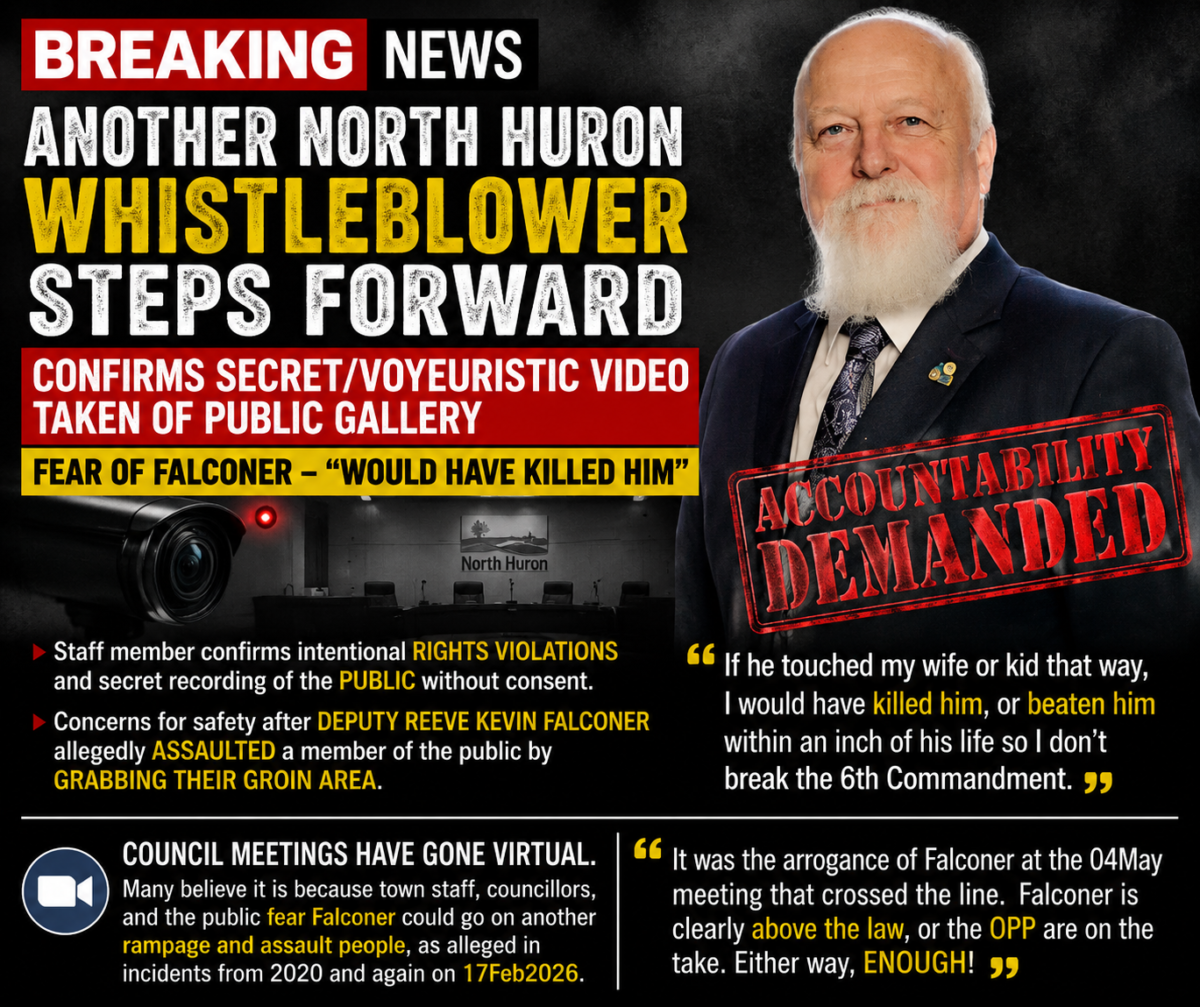
(Wingham, North Huron) A North Huron staff member has come forward with explosive allegations, claiming intentional rights violations and the secret recording of members of the public without their consent or knowledge. North Huron staff members have also reportedly expressed concerns for their safety after Deputy Reeve Kevin Falconer allegedly assaulted a member of the public by grabbing their groin area.
“If he touched my wife or kid that way, I would have killed him, or beaten him within an inch of his life so I don’t break the 6th Commandment.”
Council meetings have now gone virtual. Many believe it is because town staff, councillors, and members of the public fear Falconer could go on another rampage and assault people, as alleged in incidents from 2020 and again on 17Feb2026.
“It was the arrogance of Falconer at the 04May meeting that crossed the line. Falconer is clearly above the law, or the OPP are on the take. Either way, ENOUGH!”
Members of the public and Press are encouraged to contact council to confirm that town staff were ordered to record the public at council meetings without their knowledge or consent, a violation of the North Huron policy and bylaws. “It’s like they were getting off on the abuse of power and secrecy”
(Wingham, North Huron) — A media firestorm is brewing as North Huron faces mounting pressure to abandon its illegal virtual council meetings and return to in-person governance, as directed by the Ontario Ombudsman.
Cameras are coming. Questions are coming. Accountability is coming.
And council knows it.
In a stunning reversal, North Huron has already backed down on one front—agreeing to stop the arrest and intimidation of citizens and journalists in the public gallery who were peacefully exercising their constitutional rights. Let that sink in: a municipality had to be pushed into simply following the law.
That alone tells you how far things have gone.
But the bigger question remains: what are they still hiding?
On February 17, 2026, Deputy Reeve Kevin Falconer was asked a simple, lawful question: “Now that the recording ban is gone, will public questions return?”
Instead of answering, Falconer allegedly responded with vulgar comments and aggressive conduct—an incident witnessed and documented. To date, the OPP have failed to lay charges or even take formal statements, raising serious concerns about accountability and selective enforcement.
This isn’t just about bad behavior—it’s about power.
Critics say North Huron council has silenced the public while driving taxes to the highest levels in Ontario. The cost? More than $1,500 per household, every year, with large portions reportedly tied up in wages and salaries for what residents describe as bloated and unproductive bureaucracy.
You pay more—while getting shut out.
That’s the trade-off.
Now residents are being urged to act. Contact council. Demand answers. Demand open, in-person meetings. Demand your right to speak, record, and hold elected officials accountable.